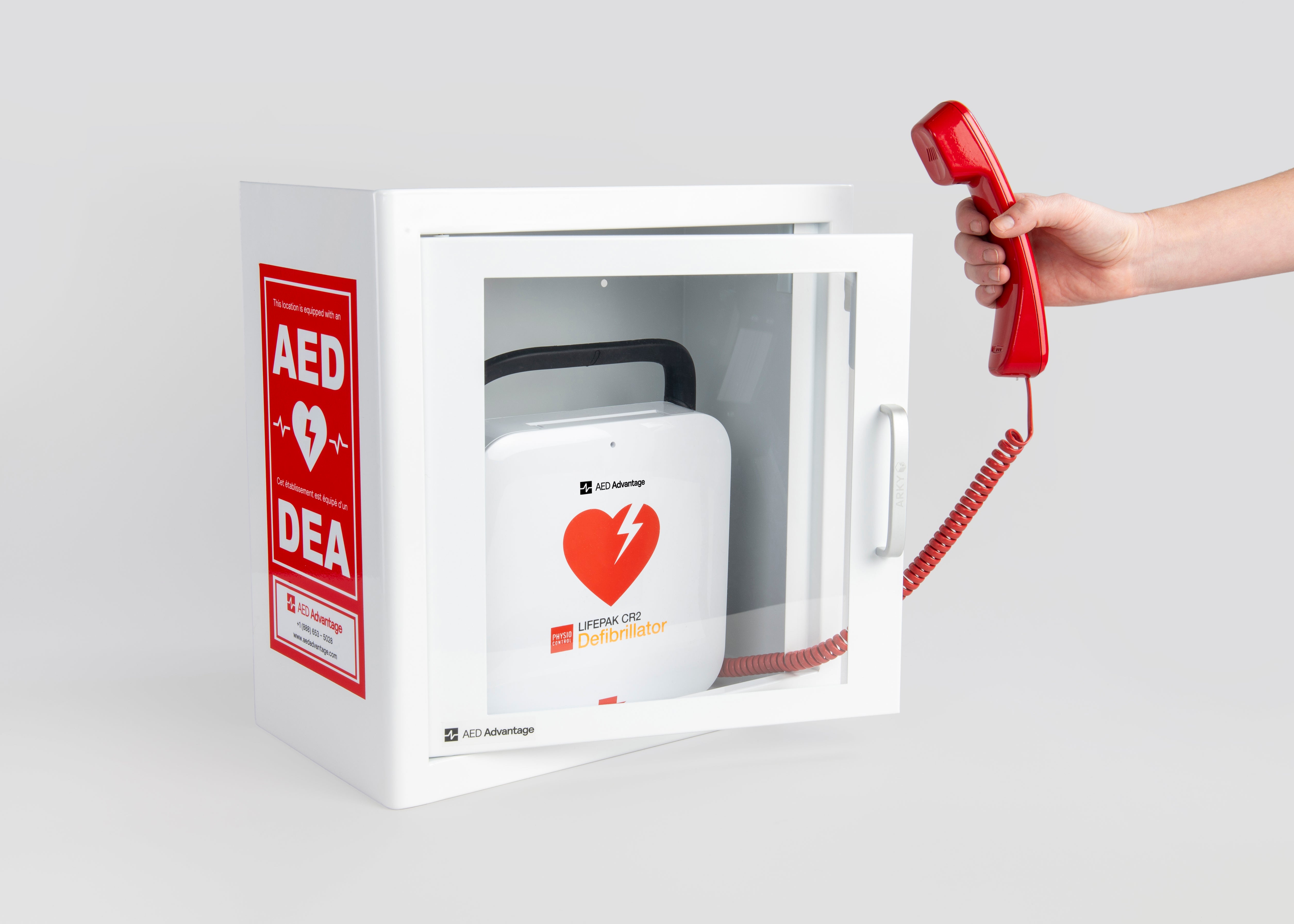
A phone being pulled out of a white and red AED cabinet made to look like a phone booth

Equipping Multiple Locations with AEDs Across Canada

If your organization is equipping AEDs at two or more locations, the process looks different than a single-facility purchase. 

A few key decisions will drive most of that work: standardizing on one AED model wherever your sites allow it; mapping coverage per location rather than applying one number across the board; and building your consumables program before the order ships, not after the first battery expires.

For more than 20 years, AED Advantage has helped multi-location organizations stay rescue-ready. We've equipped more than 21,000 organizations and deployed over 30,000 devices across Canada, many of them multi-location accounts. Below is our guidance on fleet planning, compliance, and long-term management. 

If you already know what you need, request a volume quote, and our specialists will get in touch. 

Is Your Organization a Multi-Site Deployment?

Multi-site AED deployments involve two or more locations, mixed environments, and one budget owner accountable for it all. That raises questions a single-site purchase doesn't: which model to standardize on, how to keep training consistent across staff at different sites, and how to track expiry dates without visiting every building.

We manage this type of rollout regularly, for organizations ranging from three-location retail chains to national engineering firms. Our specialist team handles fleet-level accounts directly, from model selection through long-term management, so you have one point of contact rather than separate purchases and relationships at every site.

Standardize or Mix: Choosing Your Fleet Model

Standardizing on one AED model across every site is the right approach for most multi-location organizations. It simplifies training to a single session that works everywhere, consolidates your consumables inventory, keeps maintenance on one schedule, and makes units interchangeable if one location needs a spare while another waits on a replacement part.

Mixing models may be worth considering only where sites significantly differ. For example, an outdoor loading dock or unheated warehouse alongside a standard office environment, where a higher IP-rated unit may be warranted for the harsher location.

In most cases, we recommend the LIFEPAK CR2. It offers Wi-Fi-enabled fleet monitoring, so your safety team can check device status across every site remotely, and bilingual voice prompts, which is an important factor for organizations with sites in both English- and French-speaking regions. These facilities often end up with a mismatched fleet precisely because bilingual support wasn't part of the original spec.

The CR2 is also our recommendation for fleets that include outdoor or industrial sites, since it's built to perform in cold temperatures and can typically cover both office and rougher environments under one model. For sites where cold exposure is a bigger concern, we supply heated outdoor cabinets to keep the unit within its operating temperature range year-round.

Standardizing also helps with staff turnover. When every location runs the same model, a new hire trained at one site is already prepared at any other, and your safety team maintains one set of instructions instead of a different one per device.

Our specialists review your site list during the quote process and will flag it directly if a location needs a different model from our selection of AEDs for business.

How Many AEDs Does Each Location Need?

Coverage planning is dependent on response time. The Heart and Stroke Foundation of Canada reports that survival from cardiac arrest drops 10 percent for every minute that passes without defibrillation. That's the reason placement and quantity matter as much as the device itself.

Our benchmark is a three-minute round trip: a staff member should be able to retrieve the AED and return to the person in cardiac arrest within three minutes. If you're not sure your current setup meets that mark, time it. Walk from a central point on each floor to the AED's storage location and back, and check the clock.

Unit count depends on more than square footage: 

Single-floor offices

A few thousand square feet may need only one AED near a central hallway.

Multi-floor buildings

Generally need one AED per floor, since stairwells and elevator waits can delay the rescue.

Warehouses and distribution centres

Often need more than one unit because of long walking distances and equipment blocking direct paths.

Retail locations

Do best with placement near a staffed area, such as a service desk, so the unit is never far from someone who can retrieve it.

Fleet vehicles

Including delivery trucks and service vans, need their own compact unit rather than relying on a fixed building location.

Our specialists map coverage per location during the quote process, using your floor plans and staff counts to recommend exact placement and quantity for each site.

Compliance Across Provinces

AED requirements vary by province. Some provinces mandate AEDs in specific settings, while others operate on non-binding guidelines. If your organization operates in more than one province, check the requirements for each one individually.

Workplace AED requirements by province and territory in Canada (2026)
Province / Territory Workplace Requirement Status Details
Federal (federally regulated employers) Not mandatory Government of Canada guidelines require AEDs, where used, to be placed, maintained, and checked per manufacturer instructions.
Alberta Not mandatory OHS guidelines require AEDs, where used, to be operated by someone with current CPR and AED training, with a system for skills renewal.
British Columbia Not mandatory WorkSafeBC guidance lists factors employers should weigh, including workforce size, average age and health, on-site hazards, EMS response access, and public foot traffic.
Manitoba Mandatory at designated public-access sites Fitness and sports facilities, community centres, government buildings, airports, transit stations, schools, and casinos must register and install AEDs under the Defibrillator Public Access Act. General workplaces are not included.
New Brunswick Not mandatory No current legislation or guidelines specific to AEDs.
Newfoundland and Labrador Not mandatory No current legislation or guidelines specific to AEDs.
Nova Scotia Not mandatory No current legislation or guidelines specific to AEDs.
Northwest Territories Not mandatory No current legislation or guidelines specific to AEDs.
Nunavut Not mandatory No current legislation or guidelines specific to AEDs.
Ontario Mandatory on qualifying construction sites Construction projects with 20 or more workers, expected to last at least three months, must install and maintain an AED on-site as of January 1, 2026.
Prince Edward Island Not mandatory No current legislation or guidelines specific to AEDs.
Quebec Not mandatory No current legislation or guidelines specific to AEDs.
Saskatchewan Not mandatory No current legislation or guidelines specific to AEDs.
Yukon Not mandatory No current legislation or guidelines specific to AEDs.

Source: provincial and federal occupational health and safety regulations and guidelines, current as of 2026.

Volume Pricing and Procurement

Pricing at fleet scale works differently than a single-unit purchase. At AED Advantage, volume discounts can be up to $600 per unit, with the exact discount varying by brand, model, and unit count. 

Request a volume quote through our bulk order form and include your total unit count, the models you're considering, and whether the order ships to a single address or several. We also handle mixed-device quotes, for rollouts that combine a primary model with a smaller number of ruggedized units for specific sites.

If your organization procures through a formal RFP or tender process, our specialists can help. Each tender sets its own documentation requirements, and we can prepare the pricing, specifications, and compliance paperwork it calls for. 

For organizations already running an AED fleet and looking to upgrade, our trade-in program applies up to a $400 credit per unit on multi-unit upgrades, which can reduce the cost of replacing an aging fleet. 

Your Rollout Plan: From Decision to Deployed

A multi-site deployment moves through a set of phases from decision to a fully equipped fleet.

  • Site audit and coverage mapping. Our specialists review your floor plans, staff counts, and site types to determine unit count and placement for each location.
  • Model and quantity decision. With coverage mapped, you confirm the model(s) and total unit count, along with accessories such as cabinets or carry cases.
  • Order and shipping. Once your order is confirmed, we typically ship within two to three business days. Delivery across Canada generally takes three to five business days, excluding more remote areas, so most organizations should plan for their full order to arrive within five to seven business days of confirming.
  • Installation. Your team or a local contractor handles cabinet mounting, signage, and physical setup. We support through installation guidance.
  • Staff familiarization. We offer remote familiarization sessions so your staff can operate the device confidently before they ever need it.
  • Program handoff. Once your fleet is installed, it moves to our ongoing management program, including expiry tracking and unlimited phone support.

Managing the Fleet Long Term

Multi-site fleets need upkeep for years after installation, such as tracking expiry dates, staying current on recalls, and keeping consumables stocked for replacement. Our AED Management Program supports your organization long-term. 

Every device we sell includes device-level tracking of electrode pad and battery expiry dates and each unit's physical location, at no additional cost. For accounts managing AEDs across several sites, we send a single consolidated report as expiries approach, rather than separate notices per location.

The program also includes recall handling across your fleet, consumable resupply at the volume you need, and unlimited phone support and diagnostics. As units age, our trade-in program lets you cycle to newer models without restarting your procurement process. 

Case Study: Engineering Firm Deployment Across 10 Sites

A national engineering firm came to AED Advantage managing a mixed fleet of AED models across multiple offices, the result of individual locations purchasing devices independently over several years. We worked with its safety team to select a single model for every site, standardized the fleet on the bilingual LIFEPAK CR2, and shipped units to 10 locations across Canada.

Standardizing simplified their replacement cycles immediately. CR2 pads and batteries both carry a four-year lifespan, so the team now orders consumables on one schedule instead of tracking separate timelines per device. Bilingual capability now runs across every device, so every site gets the same English and French prompts, no matter the region. 

Expiry dates and unit locations across all 10 sites are now tracked in one system, so the safety team checks a single source instead of following up site by site.

Frequently Asked Questions

Discounts scale with order size. A five-unit order typically saves $300 to $400, and orders beyond five units typically save $500 or more, with the exact amount varying by brand. Request a quote through our bulk order form for a number specific to your fleet.

In most cases, yes. Standardizing on one model simplifies training, consumables, and maintenance across every site. Mixing models makes sense only where specific locations, such as unheated outdoor sites, require different capabilities.

Yes. Manitoba mandates AEDs at designated public-access sites, and Ontario now requires them on qualifying construction projects. Most other provinces rely on non-binding guidelines rather than legal requirements, so check the rules for every province your organization operates in.

Yes. We can ship a single order to multiple addresses, which is common for organizations equipping several sites at once. 

Our AED Management Program tracks expiry dates and unit locations for every device at no extra cost, and sends one consolidated report for multi-site accounts as expiries approach.

Yes, we work with RFPs and tenders. Each issuing organization sets its own documentation requirements, and we prepare what’s needed for submission.

Ready to Equip Every Location?

With over 20 years of equipping organizations across Canada, our team can map your sites, confirm your volume pricing, and deploy every location on one plan. Request a volume quote or talk to a specialist to get started.

Explore our AED Management Program to see how we support your fleet after it ships.