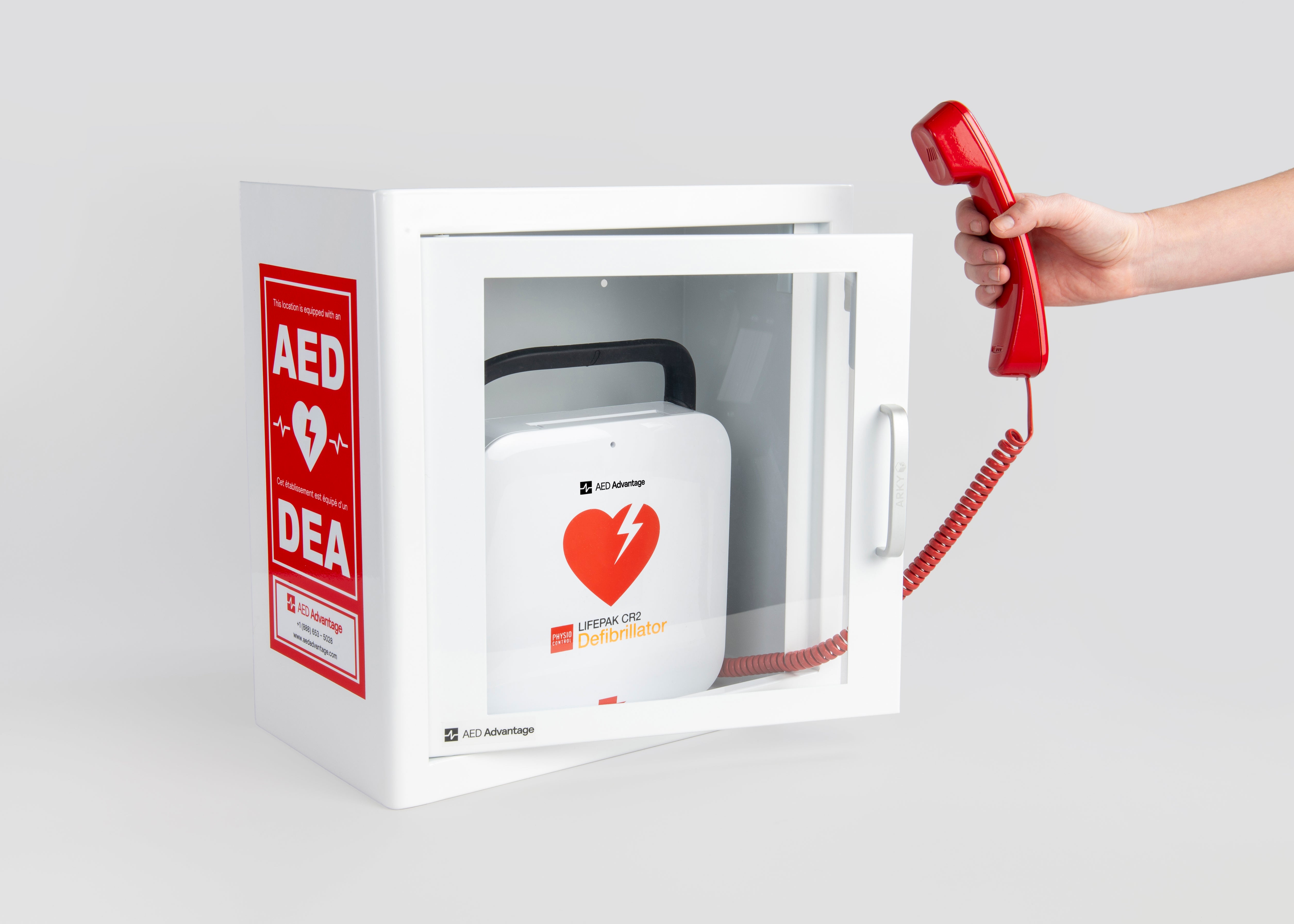
A phone being pulled out of a white and red AED cabinet made to look like a phone booth

Ontario AED Requirements (2026): Which Laws Apply to You

Reviewed October 2026

Ontario AED requirements depend on the type of site you're responsible for. Since January 1, 2026, larger construction projects must keep an automated external defibrillator on site. Most other private workplaces have no AED mandate.

Match your site to its law in the table below, then find the related specific obligations. We reviewed this page in October 2026, but keep in mind it's general information for safety and facilities professionals, not legal advice.

Is an AED required at your site?

As of January 1, 2026, Ontario law requires an AED on larger construction projects, but most other workplaces and public premises have no AED mandate.

Ontario AED requirements by workplace situation and governing law
Your situation AED required? Governing law What it means
Construction project, 20+ workers, three months or longer Yes O. Reg. 157/25 Full AED setup, regular inspections, and a trained worker every shift
Construction project below those thresholds No O. Reg. 157/25 No mandate, but check WSIB reimbursement eligibility
Designated public premises Not yet in force Bill 141 Enacted 2020, awaiting proclamation
Office, retail, or other private workplace No AED mandate Regulation 1101 First aid kits and trained workers apply
Anyone using an AED in an emergency Protected Chase McEachern Act Good-faith users are shielded from civil liability

Construction projects: O. Reg. 157/25

Since January 1, 2026, Ontario construction projects expected to last three months or longer with 20 or more regularly employed workers must have an AED installed and maintained on site.

O. Reg. 157/25 added this rule as section 27.1 of O. Reg. 213/91, the construction regulation. Here’s what the constructor needs in place on every qualifying project.

Device

The AED must be licensed as a medical device by Health Canada.

Stored kit

Keep a cardiopulmonary resuscitation (CPR) mask, scissors, two pairs of disposable medical-grade gloves, a disposable razor, a garbage bag, and four absorbent towels with the AED.

Storage

Store the AED and kit together in an unobstructed spot, protected from dust and moisture. Outdoor storage must also protect the AED from extreme temperatures and direct sunlight.

Signage

Post signs with a heart-and-lightning-bolt symbol and "AED" or "Automated External Defibrillator" (or the French equivalent) at the device and across the project.

Inspections

A competent worker inspects the AED quarterly, per the manufacturer's instructions. The record stays with the device, listing each date and the inspector's name and signature.

Training

A worker trained in CPR and defibrillator operation must be present whenever work is in progress.

Budget the device as a per-project credit. Under O. Reg. 360/25, the Workplace Safety and Insurance Board (WSIB) reimburses up to $2,500 for one AED per qualifying project, bought between July 1, 2025, and June 30, 2027. Keep the receipt with your Notice of Project, and claim before requests close on July 31, 2027.

Public premises: Bill 141, enacted but not yet in force

Ontario's public-access AED law received Royal Assent in 2020, but it takes effect only when the province proclaims it, and as of October 2026, it hasn't yet.

The law is the Defibrillator Registration and Public Access Act, 2020, known as Bill 141. Once proclaimed, it will require owners and operators of designated premises to install AEDs. The province hasn't yet named which premises those are.

Facilities that already have an AED will also take on specific duties. The device must be easy to reach, clearly marked, maintained and tested per the manufacturer's guidelines, and supported by trained staff.

Each AED must be registered with a provincial registrar within 30 days of installation, and devices already in place get 30 days from the day the rule takes effect. Owners must also report when a device moves or leaves the premises.

You can get ahead of it today. Keep a file for each AED with its model, serial number, location, installation date, and inspection history, and registration becomes a simple administrative task.

Our AED Management Program makes record-keeping easier by tracking maintenance, expiry dates, and warranties, with AED experts on hand to answer any questions. 

General workplaces: what Ontario requires

Most Ontario workplaces outside construction aren't legally required to have an AED, but Regulation 1101 does require first aid.

Regulation 1101 under the Workplace Safety and Insurance Act sets first aid rules for employers covered by WSIB. It requires first aid stations with stocked kits and workers with valid first aid certificates. Kit contents and training levels scale with the number of people on each shift.

An AED isn't part of Regulation 1101, so adding one is an individual decision. Many organizations make it part of their duty of care to staff and visitors, and some do so at an insurer's request.

If you use an AED: the Chase McEachern Act

Ontario's Chase McEachern Act protects people who use an AED in good faith during an emergency from civil liability, unless they're grossly negligent.

The Chase McEachern Act (Heart Defibrillator Civil Liability), 2007 exists so bystanders act in those first minutes instead of hesitating. It protects volunteers who step in without expecting payment. Mention it in your training briefings, because staff who know they're protected are more willing to act.

Owners and occupiers who make an AED available in good faith are protected too. Note that protection doesn't extend to an owner who is grossly negligent in making the AED available or who fails to maintain it. A documented inspection routine shows you cared for the device properly.

Staying compliant

Staying compliant means confirming which law applies to your site, then maintaining the required equipment, records, and training. 

  1. Confirm your situation. Identify the law that governs your site and check its current text, since requirements and in-force dates can change. Our AED requirements table gives a quick first match. 
  2. Deploy to spec. If O. Reg. 157/25 applies, choose from our Health Canada-licensed AEDs and add an AED Rescue Pak, which includes all required kit items. All-in-one packages that include the AED, storage options, and kits are also available. 
  3. Claim your reimbursement. Submit one WSIB request per qualifying project before July 31, 2027.
  4. Assign inspections. Designate a competent worker for each AED and put the quarterly check on your inspection calendar.
  5. Post signage. Mount AED signs at the device and along the routes that lead to it.
  6. Keep records registration-ready. Hold each device's details on file so you can register within 30 days once Bill 141 takes effect.

Want the compliance handled for you? Talk to a specialist about a compliant deployment. With over 20 years of experience, our team can match the AED, storage, signs, and inspection plan to your site.

Frequently Asked Questions

As of October 2026, Ontario law requires AEDs only on larger construction projects. Other workplaces covered by the WSIB must meet first aid rules, which don't include an AED. Public premises will face AED duties once Bill 141 is proclaimed, but that law isn't active yet.

An Ontario construction project needs an AED when 20 or more workers are regularly employed there and the work is expected to last at least three months. The rule took effect January 1, 2026. Projects scheduled to wrap up in under three months are exempt, whatever the crew size.

Construction businesses can recover up to $2,500 from the WSIB for one AED per qualifying project. The AED must be purchased between July 1, 2025, and June 30, 2027. Requests go through your WSIB online services account, and the final deadline to apply is July 31, 2027.

Bill 141 is not in force as of October 2026. The Defibrillator Registration and Public Access Act, 2020 received Royal Assent in June 2020, but it starts only when the province proclaims it. After that, covered premises will have 30 days to register their AEDs.

Yes, a worker trained in CPR and defibrillator operation must be on site whenever work is underway on a project covered by O. Reg. 157/25. Anyone can still use the AED in an emergency. The Chase McEachern Act protects bystanders who use it in good faith.

Not sure which rule fits your site? Our AED specialists can help.