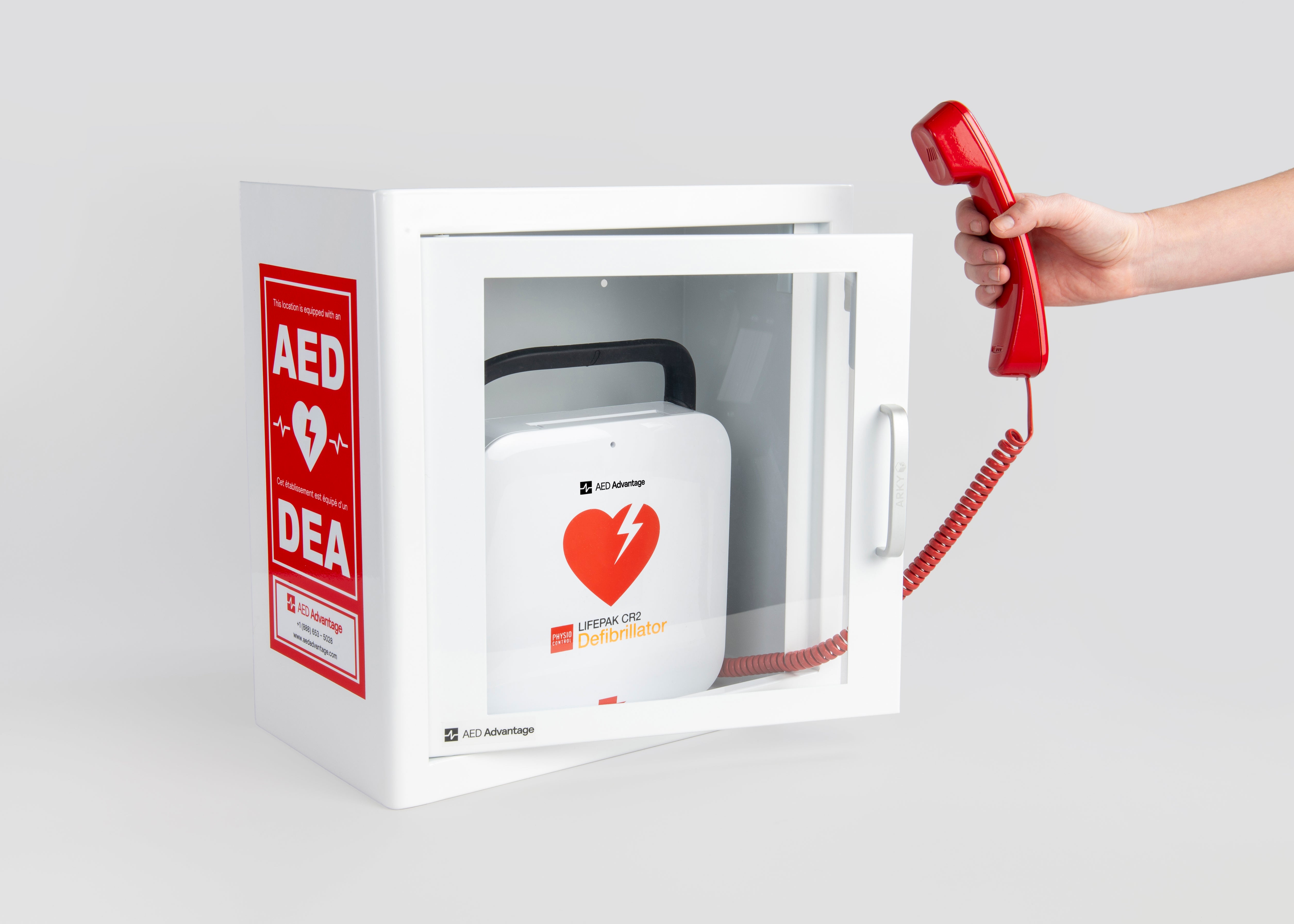
Ontario AED Requirements (2026): Which Laws Apply to You
| Your situation | AED required? | Governing law | What it means |
|---|---|---|---|
| Construction project, 20+ workers, three months or longer | Yes | O. Reg. 157/25 | Full AED setup, regular inspections, and a trained worker every shift |
| Construction project below those thresholds | No | O. Reg. 157/25 | No mandate, but check WSIB reimbursement eligibility |
| Designated public premises | Not yet in force | Bill 141 | Enacted 2020, awaiting proclamation |
| Office, retail, or other private workplace | No AED mandate | Regulation 1101 | First aid kits and trained workers apply |
| Anyone using an AED in an emergency | Protected | Chase McEachern Act | Good-faith users are shielded from civil liability |

Device
The AED must be licensed as a medical device by Health Canada.

Stored kit
Keep a cardiopulmonary resuscitation (CPR) mask, scissors, two pairs of disposable medical-grade gloves, a disposable razor, a garbage bag, and four absorbent towels with the AED.

Storage
Store the AED and kit together in an unobstructed spot, protected from dust and moisture. Outdoor storage must also protect the AED from extreme temperatures and direct sunlight.

Signage
Post signs with a heart-and-lightning-bolt symbol and "AED" or "Automated External Defibrillator" (or the French equivalent) at the device and across the project.

Inspections
A competent worker inspects the AED quarterly, per the manufacturer's instructions. The record stays with the device, listing each date and the inspector's name and signature.

Training
A worker trained in CPR and defibrillator operation must be present whenever work is in progress.
Frequently Asked Questions
As of October 2026, Ontario law requires AEDs only on larger construction projects. Other workplaces covered by the WSIB must meet first aid rules, which don't include an AED. Public premises will face AED duties once Bill 141 is proclaimed, but that law isn't active yet.
An Ontario construction project needs an AED when 20 or more workers are regularly employed there and the work is expected to last at least three months. The rule took effect January 1, 2026. Projects scheduled to wrap up in under three months are exempt, whatever the crew size.
Construction businesses can recover up to $2,500 from the WSIB for one AED per qualifying project. The AED must be purchased between July 1, 2025, and June 30, 2027. Requests go through your WSIB online services account, and the final deadline to apply is July 31, 2027.
Bill 141 is not in force as of October 2026. The Defibrillator Registration and Public Access Act, 2020 received Royal Assent in June 2020, but it starts only when the province proclaims it. After that, covered premises will have 30 days to register their AEDs.
Yes, a worker trained in CPR and defibrillator operation must be on site whenever work is underway on a project covered by O. Reg. 157/25. Anyone can still use the AED in an emergency. The Chase McEachern Act protects bystanders who use it in good faith.


